Listen to me on my podcast on information about No Child Left Behind Act of 2001.
Wednesday, July 14, 2010

Monday, July 5, 2010
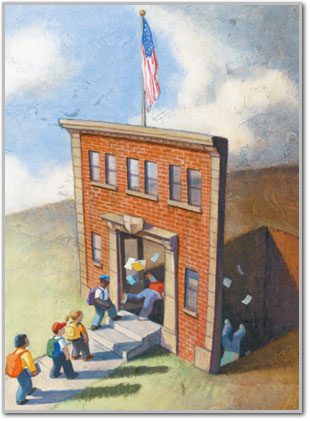
For centuries, education has played an important role in American society. It is education that has opened doors for many people. Every year hundreds of thousands of immigrants relocate to America for opportunities and a better education for their children. It is in America that you can go from the bottom to the top with the help of the American education system. Our forefathers fought hard and created a system where every child has a right to receive an education; however, over the years this notion has had many different interpretations. The No Child Left Behind Act of 2001(NCLB) is the latest version with many upgrades from the previous programs implemented by the government. Will NCLB be the last of these programs? This is highly doubtful! New research will bring in new ideas which may bring new programs that may be more effective than the older programs. Just like computers and cell phones that keep evolving, education is the same…it is an evolving process.
On January 8, 2002, President George W. Bush signed into law the No Child Left Behind Act of 2001 (NCLB), which reauthorized ESEA in dramatic ways. NCLB brought considerable clarity to the value, use, and importance of achievement testing of students in kindergarten through high school. With NCLB, a new era began where accountability, local control, parental involvement, and finding what works, became the cornerstones of the nation’s education system. The law mandated that if our children aren’t learning, we must find out why. If our schools aren’t performing, then options and help would be made available to those schools.
No Child Left Behind ensures accountability and flexibility as well as increased federal support for education. This act has four basic themes that run consistently through this federal statute: improving academic achievement of the economically disadvantaged, preparing, training, and recruiting highly qualified teachers and principals, making education more accountable, and last but not least, empowering parents to be involved in the education of their children.
Over the past 8 years NCLB has set a foundation for the education system in America. Through the evolutionary process of education, we Americans have made great strides in perfecting our educational system. I strongly believe that education in this country has not reached its full potential, but with different programs and support from federal and state government we are headed in the direction of meeting our full potential.
History of no child left behind
Check out this SlideShare Presentation:
History of no child left behind
View more presentations from naeemkhowja.
Saturday, July 3, 2010
President Bush's speech on NCLB
Speech made by former President Bush at General Philip Kearny School in Philadelphia, Pennsylvania. During his speech he discusses his views of the No Child Left Behind Act of 2001 and its impact in the education industry.
Audio
Friday, July 2, 2010
Issues & Challenges of No Child Left Behind Act of 2001
As any system whose purpose is to fix itself, NCLB lacked on foreseeing a series of drawbacks that would affect the implementation of the requirements accompanying the act. Organizations and individuals against the NCLB Act were as loud and convincing as the ones in favor. Some who favored NCLB have turned their backs on the act and are pleading the government to leave the education system alone, www.nytimes.com/2007/10/03/opinion/03ravitch.html.
NCLB sets accountability standards for teachers’ qualifications and curriculum. No one can argue that these were very much needed to bring to high standards an education system that was perishing. But also non-arguable is that the program is underfunded and yet, it required states to comply with all provisions or risk losing federal funds. The underfunding situation forced many states/districts to make budget cuts in subjects and programs that were not being scrutinized by state mandated tests and, thus, did not add to the accreditation of schools. It is true that it emphasized reading, writing, and math but it also jeopardized so many other programs vital to the development, creativity, and social growth of our kids; such as the visual and fine arts, physical education, social studies, sciences, and activities like field trips. Even though the major portion of the funds was allocated to fortify the three fundamental core subjects, parents and teachers felt (feel) that the curriculum focuses on test-taking strategies and a very limited knowledge of content. The feeling among the school community was that teachers were pressured to teach students to be successful at taking tests instead of teaching with the goal of learning.
Another major disappointment with NCLB is the structure used to close the achievement gap between achievers and non or low achievers. It imposes the requirement of providing quality education to groups that are underserved but it fails to address issues that have nothing to do with curriculum or academics and that are setting this population for failure… Social conflicts, oversized classes, and health care among others, are problems that need to be addressed before expecting students to achieve in areas that are beyond their immediate needs. Let’s not forget to add a curriculum and tests that contain cultural biases to this mix and it is very difficult not to acknowledge the overall frustration of those involved in meeting expectations.
The law requires public school to make AYP or risk being sanctioned by the federal government. The measurement used to demonstrate AYP is student’s tests scores. Interventions offered due to lack of progress in the areas of math, reading, and writing are expected to close the gap by the year 2014. It is expected that this deadline will change as well as the law itself. One of the changes will be the accountability system. Although it will still offer recognition to successful schools, it will distribute the funds according to needs and efforts of schools to comply with the law.
The NCLB has been commended for focusing attention and resources on academic achievement gaps but at the same time it has been opposed for setting impossible goals to attain and for humiliating professional staff and students branding them :in need of improvement” when they fall short.
Wednesday, June 30, 2010
References
1. A Guide to education and no child left behind. (2004, October). Retrieved from http://www2.ed.gov/nclb/overview/intro/guide/guide_pg12.html.
2. No child left behind: an overview. (n.d.). Retrieved from www.tea.state.tx.us/nclb/.
3. Will ESEA/NCLB Reauthorization Proceed in 2010?, November 2009,
http://www.fairtest.org/will- esea-reathorization-proceed.
4. Jorgensen, M, & Hoffman, Jenny. (2003, December). History of the no child left behind act. Retrieved from http://www.pearsonassessments.com/NR/rdonlyres/D8E33AAE-BED1-4743-98A1-BDF4D49D7274/0/HistoryofNCLB.pdf.
5. Sam Dillon, 02-21-2010, Obama to Seek Sweeping Change in :”No Child” Law, Retrieved June 29, 2010 from http://www.nytimes.com/2010/02/01/education/01child.html.
Subscribe to:
Posts (Atom)